




In today’s climate-conscious economy, sustainability is no longer a corporate buzzword: it’s becoming a business imperative.
For Shropshire companies still navigating post-pandemic recovery, alongside rising energy costs, and evolving regulatory landscapes, embedding environmental, social, and governance principles is not just about ethics; it’s about long-term viability.
From large manufacturers to SMEs, businesses are under pressure to decarbonise supply chains, reduce emissions, and demonstrate transparent ESG reporting.
Consumers, too, are voting with their wallets – demanding greener products, ethical sourcing, and corporate accountability.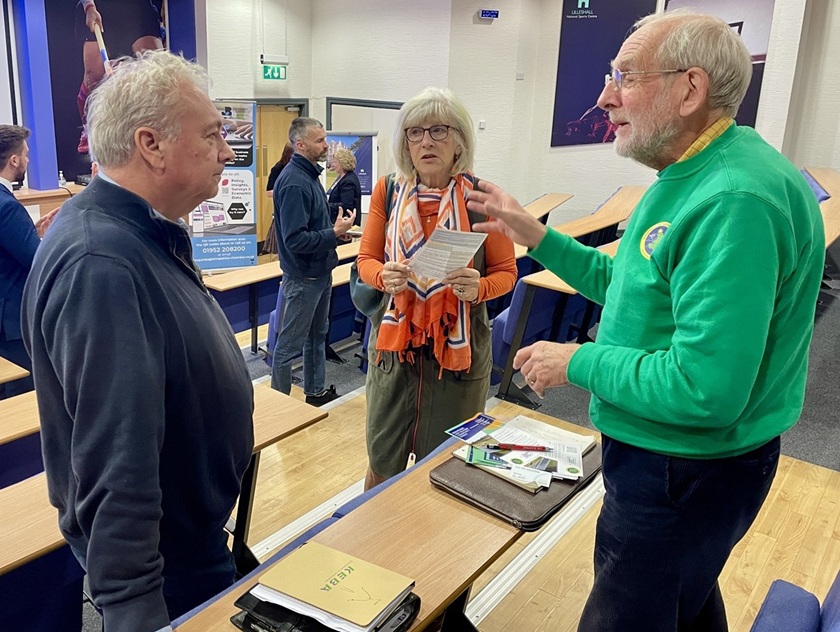
But sustainability isn’t just about compliance or reputation. It’s a driver of innovation and efficiency. There is a growing library of evidence which appears to show that employers who prioritise sustainability now outperform their peers in profitability and resilience.
The challenge lies in turning good intentions into measurable impact… and that’s where AI steps in.
Shropshire Chamber of Commerce’s new Sustainability Partnership has been exploring how artificial intelligence can accelerate the business community’s efforts to become more eco-friendly.
The lecture theatre at Lilleshall National Sports and Conferencing Centre hosted the second meeting of the group, which brought in expert speakers from as far afield as Romania.
Presentations and discussions highlighted AI’s potential to transform sustainability from a compliance challenge into a competitive advantage – from energy-efficient logistics to intelligent waste reduction, recycling, and manufacturing.
Guest speakers included Lewis Prince of Purple Frog Systems, Vlad Cazan from KFactory, Jordan Tassell of iconsys, Denise Brinton from Staysafe PPE, and Howard Betts of Shropshire and Telford Community Energy.
Lewis – a senior AI engineer at Telford-based Purple Frog Systems – explained why the use of smaller AI models had the potential to lower a company’s costs and environmental impact – highlighting Google’s revelation that the powering of its AI functions is a main factor in its 27% rise in electricity use last year. That figure has probably risen even higher this year.
Vlad Cazan jetted in from Romania to deliver a presentation at the event. He outlined a case study showing how AI systems had immediately reduced emissions at one automotive company by 5%, and increased managers’ time to focus on their core activities by 30%.
“It is dangerous to have a 100% reliance on things like ChatGPT because of the ‘garbage in, garbage out’ principle, but if you think artificial intelligence is the future you are falling behind – because it is already a big part of our lives,” he said.
Jordan, head of marine and ports at Telford-based iconsys, explained how his company’s ‘smart power management system’ was helping to optimise the use of energy both at sea and at ports, sparking debate about how similar principles could also be used in agriculture.
And Denise, managing director of Alveley-based Staysafe PPE, revealed how her business kept track of every single kilogramme of workwear and PPE equipment given to them for recycling or re-purposing.
She said she was ‘amazed’ that the family-run firm was still the only one of its kind in the area – since it recovered over 420 tonnes of waste last year, saving nearly 6,000 tonnes of emissions.
The session was chaired by Andy Whyle of Sustainability West Midlands who said: “We need to understand what the business pain is in relation to sustainability, because the more sustainable we all become, the better this place is for us to live, work and play.
“The success of this partnership is going to be based around joining up businesses with solution providers.”
Jenny Pearson, head of commercial success at Shropshire Chamber, said: “Uniting Shropshire businesses in the common cause of creating not only a more sustainable future, but also a more sustainable present is invaluable.”
The broad conclusion from the Lilleshall event was that artificial intelligence offers Shropshire businesses a toolkit for smarter, faster, and more sustainable decision-making. From predictive analytics to intelligent automation, it can help organisations reduce their environmental footprint while boosting productivity. For example:
To truly harness AI for sustainability, businesses must fully integrate it into their environmental, social and governance strategies from the outset. What does this look like?
Embracing data-driven decision-making, for starters. ESG success depends on robust data. AI thrives on data, making it ideal for tracking emissions, monitoring compliance, and generating real-time sustainability insights.
Then there’s ethical Ai governance. Just as businesses are held accountable for their environmental impact, they must also ensure their AI systems are transparent, fair, and free from bias. Ethical AI frameworks should be part of any sustainability roadmap.
As AI reshapes job roles, it’s also important for businesses to invest in training and reskilling their workforce. This not only supports a just transition but also ensures that staff can contribute meaningfully to sustainability goals.
Where you take things from here depends almost entirely on your answer to these two questions.
Do you treat sustainability as a cost to your business, or a catalyst?
And do you view AI as a threat, or a transformative tool for good?