

14 November 26
Operational intelligence: The next level
CARL JONES meets the brains behind a potentially game‑changing AI platform built in the heart of Shropshire
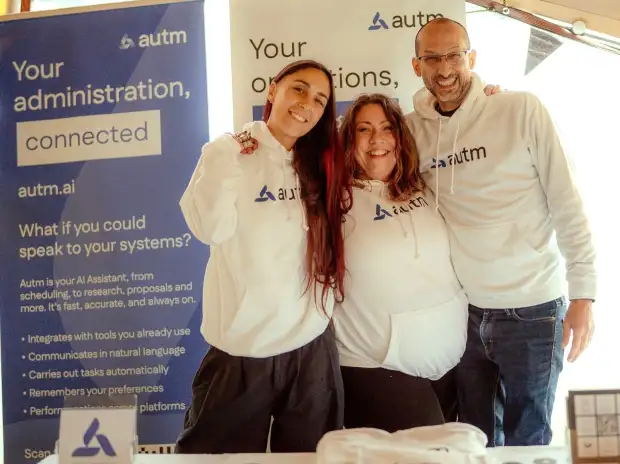
There’s a running joke in the Shrewsbury office of Autm.ai that its founding moment happened in a traffic jam on the M6. There’s more to it than that, of course – but the story does contain an element of truth.
When Paul and Jeannie McGillivray pulled away from a business mastermind event in London late one evening, facing three and a half hours of motorway ahead of them, they had an idea that would consume the next 14 months of their lives… and potentially transform the way businesses harness artificial intelligence.
Jeannie recalls: “As we got into the car I said to Paul, we must be able to build some kind of platform for people who just want to speak into a tool or write into a tool and have it build the workflow for them, so all that background information and programming is automatic.”
Paul reached for his laptop immediately...
The McGillivrays are certainly not newcomers to the technology world. For nearly three decades they have run Remote – a custom software development company building systems for businesses of all shapes and sizes.
Paul is also the author of ‘Scope To Scale’, a guide for leaders seeking to harness the power of transformative software to lighten workloads and boost corporate momentum.
That accumulated experience gave them something rare: a deep, practical understanding of how organisations actually work – what Paul calls systems thinking.
“For more than 25 years we've been going into businesses, applying systems‑thinking processes, and we've seen what runs through every business, whether it's a solopreneur or a giant corporation,” he says.
It was that insight – the certainty that universal patterns repeat across every business, whatever their size or sector – that gave the duo the confidence to build something genuinely new.
The seed of Autm was planted even before the motorway moment. Paul describes the point at which he decided enough was enough. As Remote’s founder, he had long since stopped writing code; instead, his days were consumed by proposals, workshops, transcripts, scoping documents and system designs. A single proposal could take two weeks from start to finish.
“I was like, ‘I'm done’,” he says. “I thought, surely I can build a suite of AI agents that does this for me. And so I did – and it turned that two‑week process into an hour.”
Excited by this almost instant success, the couple shared what they had built with their mentor and friend Shaa Wasmund MBE, who has spent more than two decades building, backing and advising businesses, raising capital, and helping founders scale. She is currently a leading light in the new Zuffa Boxing movement, gaining strong traction on Sky TV.
Jeannie says: “She told us we needed to run a mastermind on this, because she felt it was incredible. She said it had the potential to change everything.”
So they ran the mastermind – and the morning session showcasing existing AI tools was a big hit. But the afternoon, where the cohort was taught to build their own AI workflows using platforms like Lindy and n8n, was a disaster.
Delegates got lost. They missed steps. They didn’t understand the context. By the end, they were asking Paul and Jeannie a simple, revelatory question: “Can’t we just pay you to do it?”
“I didn’t know if this meant it was a great success or a terrible disaster,” Jeannie admits. “But it told us the market didn’t want to build AI workflows. It wanted the outcomes those workflows could deliver.”
Autm was born. Over the past few months a small and select sample of employers have been helping to test the service, and it has now been fully unleashed.
At its core, Autm is an AI platform that sits on top of the tools a business already uses – email, CRM, Stripe, PayPal, Google Drive, Slack and many more. It pulls all the relevant information into one central, intelligent hub. On top of that sits an AI agent you can speak to or type into, and beneath it runs a suite of automated workflows that carry out tasks on your behalf.
“Businesses have more software, more information and more communication than ever, but much of it remains disconnected,” says Paul. “The aim is to reduce the cognitive load so you can get on with the bits you love about your business, not the admin.”
So you can ask Autm what your profit looks like on a specific project. Have it monitor your CRM for hot leads and Slack you if one looks promising. You can instruct it to take all the data from one CRM, migrate it to another, research each contact online, and flag any you haven’t followed up.
Paul says: “A good example is if a lead comes into my CRM via a form on my website, it will go online, find out about that person, enrich the data, and Slack me if they're a good lead.”
He says the philosophy behind the design is deliberately human. “Nobody cares about AI agents. People don’t need AI agents. People need the outcome an AI agent can deliver. The opportunity with AI is much bigger than simply giving people another place to ask questions.
“When AI can securely understand the context that already exists across an organisation and work across the systems people use every day, it becomes capable of helping co-ordinate how work actually gets done.”
As exciting as all this sounds, it’s Autm’s approach to data security that could prove to be the real game‑changer.
In a world where businesses are rightly sceptical of AI companies’ promises about data privacy, the McGillivrays took a radical step: Autm redacts all personally identifiable information – names, email addresses, financial figures, project names – before any data is sent to a large language model.
“The agent never actually sees your personal data,” explains Paul. “It just sees the patterns around the personal data. We don’t know of anyone who’s tackled that and succeeded yet.”
For law firms, accountancy practices, healthcare providers, and any business handling sensitive client data, the duo believe this single feature could make Autm uniquely adoptable where others provoke mistrust.
Jeannie continues: “Businesses have no shortage of software with the explosion of subscription‑based platforms, but they do have a shortage of any of them being joined‑up so their information isn’t fragmented across them.
“Important decisions are made in meetings, commitments are buried in emails, knowledge sits inside documents, spreadsheets and systems, and actions can easily disappear between one platform and another.
“We built Autm to connect all of that together. The ambition is to give an organisation a layer of intelligence across the business that understands the context, remembers what is happening and helps people act on it.”
She adds: “We’re very proud that this has been built here in Shropshire. There is sometimes an assumption that ambitious technology companies have to be built in London, Silicon Valley or one of the major technology centres. They don’t.
“We want to build something globally significant from Shropshire and help businesses here and elsewhere understand what this next generation of AI can actually do for them.”
There is also a bigger political dimension to all of this. The recent episode of the US restricting access to one of its most powerful AI models – before quietly making it available again, but this time with a hugely inflated price tag – brings a degree of vulnerability to UK businesses.
“The fact that a country outside of the UK can cut us off from a core piece of technology is frightening,” says Paul. “We want to bring that technology home, and we want to keep it home.”
Their ambition is to build a Made in the UK platform that is also fully compliant with the EU AI Act, so businesses of any size can adopt AI without fear of geopolitical risk or regulatory exposure.
Jeannie says: “Shropshire was at the very heart of the last industrial revolution. It’s only right that we should be playing a leading role in the next one. You don’t need to be living in San Francisco or London to create amazing technology.”
· Listen to more of Carl’s chat with Paul and Jeannie on the Shropshire Business podcast, available on the Podbean platform or at www.shropshirebiz.com
Share this story




Related articles

The Visitor Economy

Place management leader won over

Why do young people feel judged?

Building the future workforce

A crisis of confidence?
A chance to influence the skills pipeline
VIDEO: Huge celebrations as winners crowned
In it for the long haul

Great expectations for tasty venture